


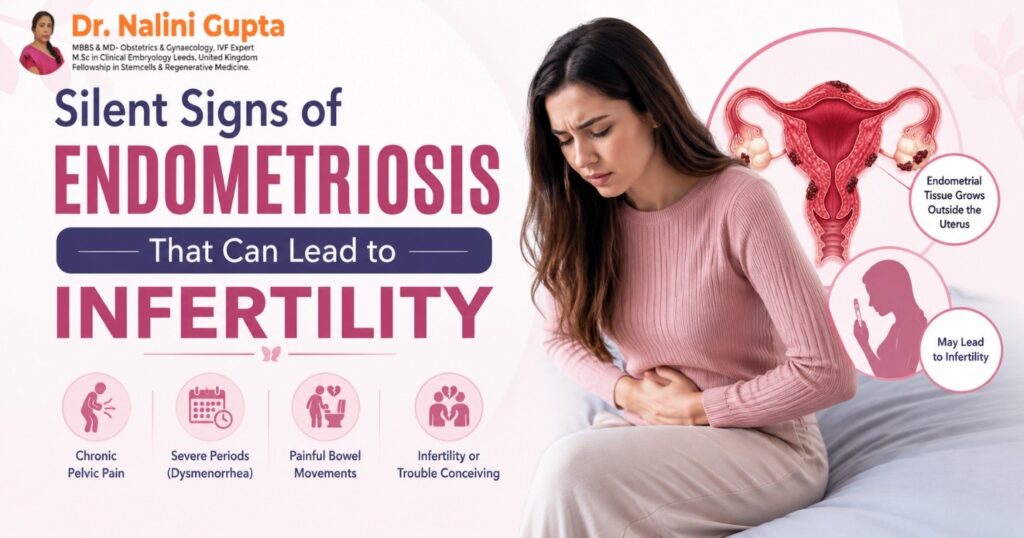
Endometriosis is one of those conditions that most women carry for years without knowing it is there. The early signs include painful periods, discomfort, and other symptoms often dismissed as stress or diet issues. Most women find out they have endometriosis when it’s too late.
What is endometriosis?
Tissues that belong inside the uterus start growing outside of it, around the ovaries, along the fallopian tubes, and sometimes also near the bowel. Every month, when your hormones shift, that tissue starts behaving exactly like it would inside. These tissues start to swell and bleed but have nowhere to go. So it stays. It inflames. It scars. And over time, it changes things in ways that matter enormously when you want to have a child.
What makes endometriosis genuinely tricky to catch is that it disguises itself as ordinary discomfort. Painful periods? Normal, apparently. Feeling off around your cycle? Just hormones. The average woman waits close to a decade between her first symptom and an actual diagnosis. A decade. That’s not a gap — that’s a canyon.
The Signs That Are Easy to Wave Away
Periods that genuinely stop your day are not something to push through silently. Not “a bit uncomfortable” but the kind of pain that has you cancelling plans, calling in sick, and lying flat waiting for it to pass. Endometriosis pain has a particular persistence to it, and if that sounds familiar, it’s worth saying out loud to someone who can actually investigate it.
Pain during sex is another one. Deep, uncomfortable, sometimes sharp, and rarely mentioned at a doctor’s appointment because it feels too personal or too awkward to bring up. It’s one of the more telling signs and one of the least reported. If this is your experience, it belongs in that conversation.
Then there’s the bloating, the bowel changes, and the discomfort when you use the bathroom, all of it arriving and leaving with your cycle like clockwork. Easy to blame on food, on stress, on just being the way you are. But patterns that follow your hormones aren’t random.
And that dull background ache in your pelvis? The one that’s just sort of always there, even between periods? That’s not nothing either.
What It’s Actually Doing to Your Fertility
Even mild endometriosis creates a chronic inflammatory state inside the pelvis that quietly affects everything: egg quality, ovulation, and the conditions needed for an embryo to implant. Endometriomas, the cysts that form on the ovaries because of endometriosis, chip away at ovarian reserve over time. Fewer eggs. Sometimes lower quality. And a fertility picture that becomes harder to work with the longer it goes unaddressed.
This is why timing matters so much with endometriosis. The earlier it’s caught, the more options exist.
When Do You Actually Go?
If you’ve been trying to conceive for twelve months without success, or six months if you’re over 35, stop waiting for next month to be different. Unexplained infertility and endometriosis are far more connected than most people realize, and the investigation needs to go deeper than a standard checkup.
Dr. Nalini Gupta at KIC Delfinium Fertility Centre in South Extension has spent over 30 years doing exactly that kind of deep, personalised investigation. With 4,000+ families helped and a reputation as the Top infertility Clinic in Delhi, she approaches each case — including those involving endometriosis — with ovarian reserve testing, endometrial health assessments, hormonal profiling, and treatment options from IVF to ICSI, all built around what that specific woman actually needs.
If you’ve been searching for the best infertility doctor in Delhi because something feels off and nobody has given you a real answer yet, this is a good place to start, because endometriosis doesn’t announce itself.
Common Questions Women Ask About Endometriosis
1. What are the indications of endometriosis?
The first signs of endocrine dysfunction consist of severe menstrual cramps constant pelvic pain, a uncomfortable menstrual cycle, heavy period and fatigue, as well as bloating and pain during the bowel movement or when you urinate. A lot of women misinterpret these symptoms as normal issues related to their period and delay the diagnosis.
2. Can endometriosis cause infertility?
Yes. Endometriosis may affect fertility by creating inflammation, scarring adhesions and scars and blocked fallopian tubes as well as ovarian cysts known as endometriomas. The changes may interfere with fertilisation, ovulation and embryoimplantation, causing the conception process more challenging.
3. What is the best way to diagnose endometriosis?
Endometriosis is typically diagnosed by an amalgamation of the pelvic exam as well as ultrasound scans MRI imaging and, occasionally laparoscopy. This is thought to be to be the most reliable method of confirmation of the diagnosis.
4. Do I have the ability to get pregnant naturally If I have endometriosis?
A lot of women suffering from mild to moderate endometriosis may still be able to get pregnant naturally. But, the chances of having a child decrease with the progression of the disease. A timely diagnosis and prompt fertility assessment can greatly increase the chance of pregnancy.
5. When is endometriosis the most frequently recognized?
The most common diagnosis for endometriosis is among women aged between of 25-40. But, the symptoms can manifest in the teen years, and are often undiagnosed for a number of years.
6. What is the best time to see an endometriosis specialist?
It is recommended to consult with an expert in fertility in the event that you experience intense menstrual pains, tried to get pregnant for longer than 12 consecutive months (or six months if you have a higher age than 35) or diagnosed with endometriosis, and you are considering the birth of a child.
Conclusion
The endometriosis issue is more than painless periods. It’s an ongoing condition that may cause problems with fertility and reproductive health over a long period of time before being recognized. Signs of the disease like severe menstrual discomfort, pelvic pain, an uncomfortable and painful period, as well as unanswered infertility shouldn’t be overlooked. If you can identify endometriosis earlier and treated, the better the chance of keeping fertility intact and having access to the most effective treatments. If you believe the symptoms you are experiencing go beyond normal hormonal fluctuations, seeking an professional medical advice will make a big impact. An early diagnosis, customized treatment and proper plans can aid women with endometriosis have a successful pregnancy and increase their overall health.